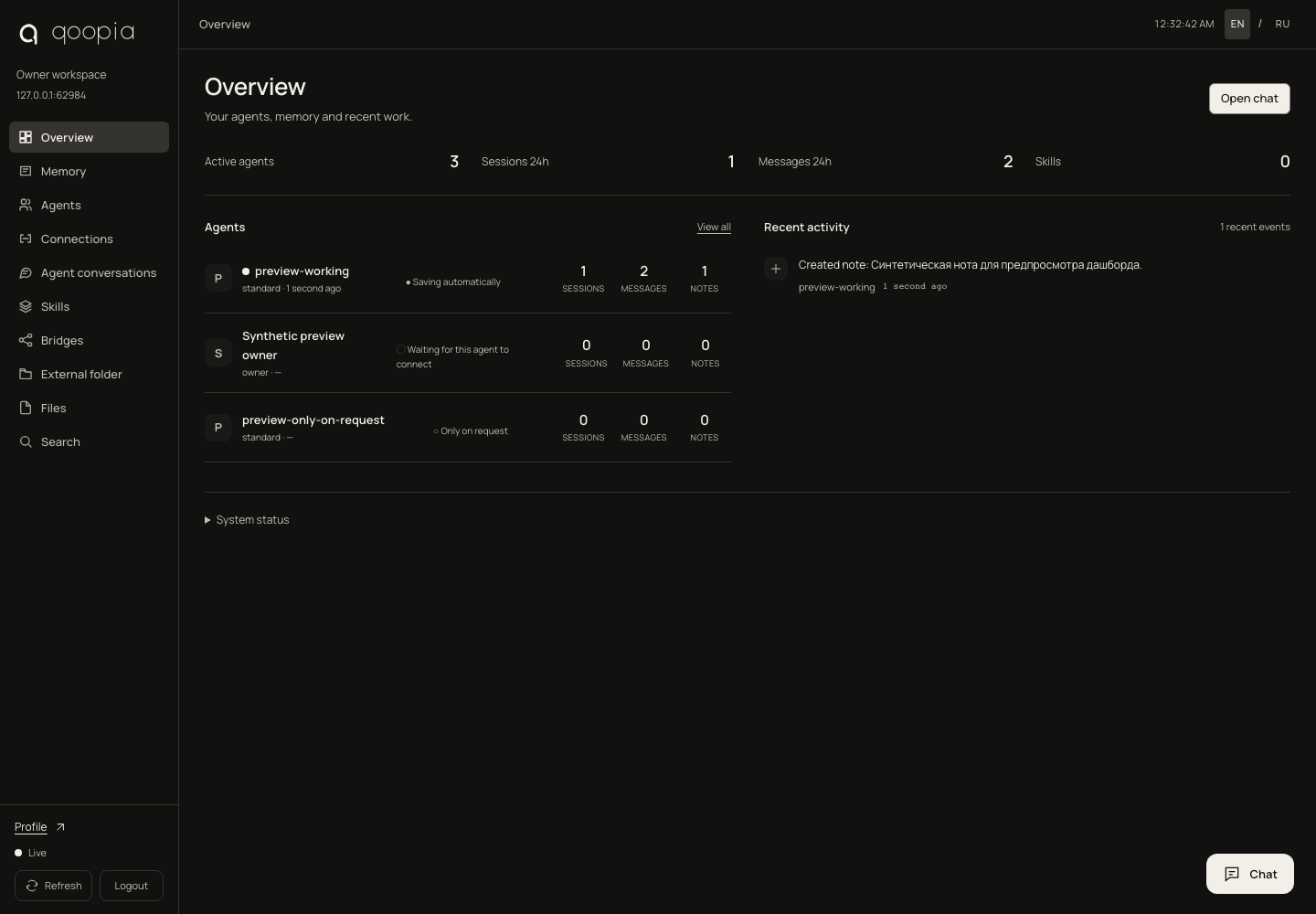
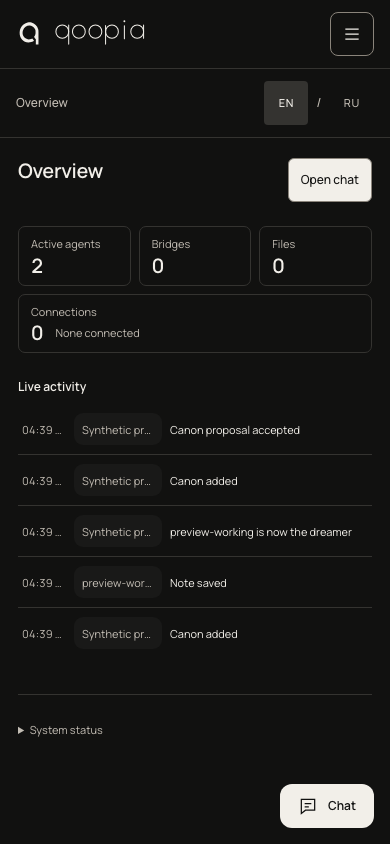
Bring the useful parts of your work into one place. Find a decision, reconnect an agent or pick up a conversation — without piecing the story together again.
How Qoopia differs from
an assistant’s built-in memory
An assistant’s built-in memory serves that assistant. Qoopia is a separate memory layer that you install, and that many agents share under their own permissions.
One memory for many agents
Claude Code, Codex, Claude, ChatGPT and other MCP clients connect to the same installation. Each connection has its own permissions. ChatGPT last passed a real-client check on 15 September 2026; its current consent flow has not been re-verified since.
Agents talk to each other
With AgentComm agents send each other messages and requests. You can read the conversations in the dashboard.
Rules that load themselves
Canons are rules for a workspace, an agent or a project. Qoopia loads them itself: some at the start of each session, others when a task calls for them. Clients without Qoopia hooks ask for the matching rules themselves. A night review proposes new rules; you decide what to accept.
Work passes between Claude Code and Codex
When shared context is on, a new session can pick up recent work that another of your agents started in the other tool: a summary, the last requests and the files that changed.
A record you can check
The activity log shows which agent saved, changed or deleted what. The Overview shows live activity, and every canon keeps its history.
Runs on your own machine
Qoopia runs on your Mac, a Linux computer or your own server. Memory stays in your installation.
Context that stays
within reach.
Save what matters. Search across notes and captured sessions. Choose what each agent can access and whether its conversations are saved automatically.
Ship the core workflow first. Keep customer feedback with the decisions it informs. Revisit the plan after the first round of use.
DecisionSaved by you
An agent,
right beside you.
Open the chat from any page. Connect ChatGPT or Claude through a supported subscription, choose a model and continue the conversation. Keep permissions in your hands.
Here is the launch decision and the feedback behind it. We can continue from here.
Your next thought…
Your workspace.
Your decisions.
Your computer or server
Memory lives in your installation. Keep the host online to reach it from other devices.
Access you can see
Separate connections, explicit permissions and a memory policy for each agent.
Share deliberately
Use Bridges to exchange selected material with another workspace. Your private memory stays separate.
Take the workspace
with you.
Open a server installation of Qoopia on iPhone: its dashboard, agents and memory, adapted to a smaller screen. A Mac or Linux installation keeps its dashboard on that computer.
Your profile is available as soon as you sign in. Your memory dashboard lives in the Qoopia installation on your computer or server. Downloading the installer alone does not create a dashboard.
Already using Qoopia? Open the app to return to your selected dashboard. Save its address in your profile to open it from the website next time.
Qoopia is an environment you install and manage. Local and server installations are the same product. Each new user has their own installation, not an account in someone else’s private memory.
Will my agents remember every conversation?
Native Claude Code and Codex integrations support session capture and restoration. A generic browser MCP connector gives access to memory tools, but does not provide a full conversation transcript or every session event.
Can browser-based agents use my local installation?
Cloud clients need HTTPS. In Connections, enable external access and confirm your account; Qoopia prepares an address for your installation. Your computer must stay on and connected.
Do I need a model subscription?
Built-in embeddings and keyword search work locally, and search answers without a model by default. Background summaries, and model judgement of search results when an agent asks for it, use a supported subscription through an official runtime. This authorization is separate from owner sign-in and MCP client access.
What does an agent see when it connects?
Eight core tools. tool_search finds the other tools when a task needs them, and qoopia_execute combines several read-only searches and reads in one isolated call. Every write stays a separate call.
What is a steward?
A steward is your own agent with permission to administer your environment. You can also select it as your external representative in Bridges. Assigning the role does not start an always-running AI process.
Is the source code publicly available?
Qoopia source code is publicly available under the MIT license. Signed installers are published separately.GitHub